Zizek and the Media by Paul A. Taylor
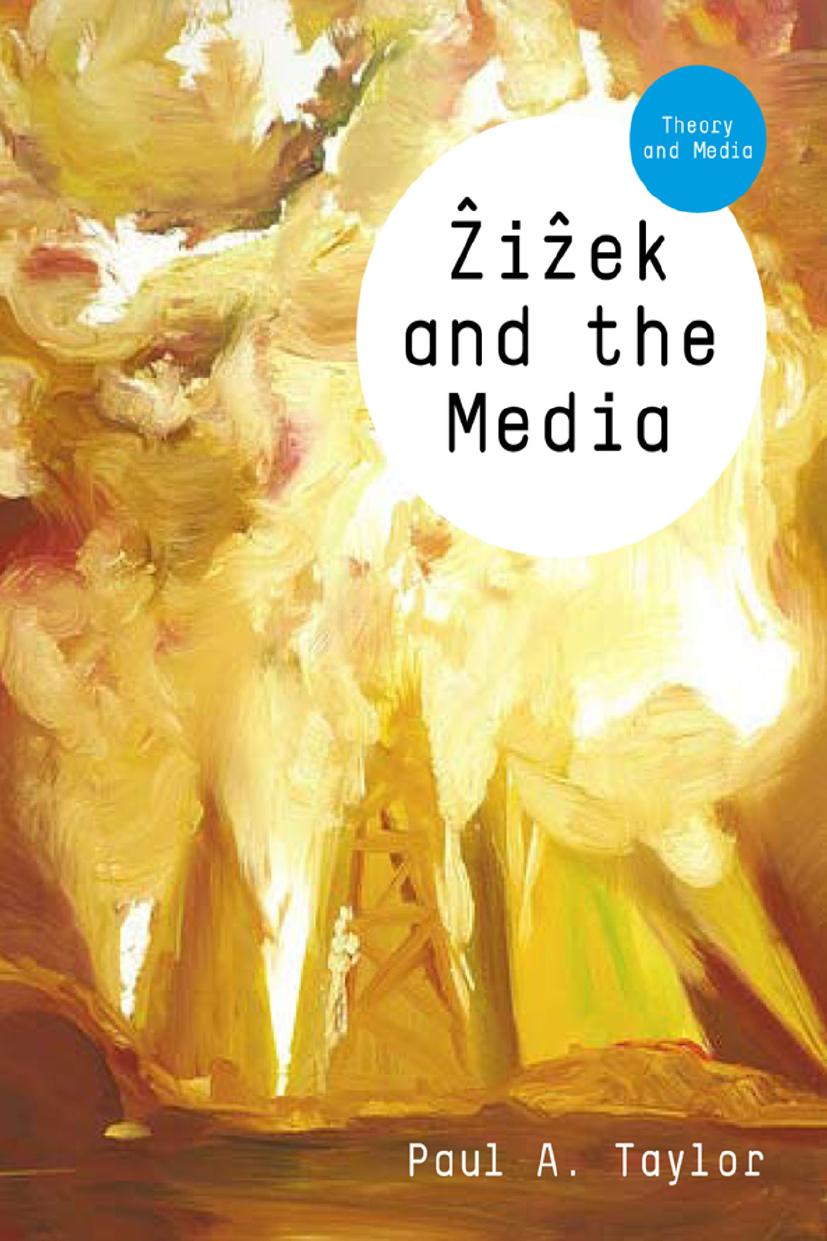
Author:Paul A. Taylor
Language: eng
Format: epub, pdf
Publisher: Wiley
5
THE MEDIAâS VIOLENCE
INTRODUCTION: MEDIATING VIOLENCE
More communication means at first above all more conflict. (Peter Sloterdijk)1
Explicitly in Violence (2008) but implicitly throughout the rest of his oeuvre, Žižek problematizes the mediaâs standard range of discourse. He explores the ideological processes involved in two main forms of violence in contemporary society: subjective and objective violence.
Subjective Violence
This is what we common-sensically understand by the notion of violence and is defined by Žižek as that which is âperformed by a clearly identifiable agentâ (Violence: 1). In other words, subjective violence refers not to any notion of an excessively personal interpretation of what constitutes violence, but rather to violence that can easily be attributed to an individual source. In media terms, it can be seen in the dramatic forms of violence frequently shown on TV news programmes and the burgeoning number of âembeddedâ journalistic reports, whether they are to be found in events like the Iraq war or the myriad reality TV shows thematically united by their devotion to violent encounters, for example various âsquad-car viewâ cop shows.
Objective Violence
ZiŽek subdivides objective violence into two parts:
(i) Symbolic violence â the basic form of violence âthat pertains to language as suchâ (Violence: 1). The cardinal philosophical point is that all communication has a violent element. The key political question rests in the type of violence that results. Thus, Baudrillard finds in the agonistic, threatening challenges laid down by anthropological forms of symbolic exchange a desirable form of communicational violence. Subtle nuances are contained within traditional rituals of gift-giving that produce a culture full of seductive ambiguities â to be contrasted with the pre-ordained, pre-enscribed cultural values transmitted within the exchange of commodities. At one level, the transmissions of this technologically mediated commodified order appear less symbolically violent than its more âprimitiveâ counterparts because less is demanded from the sender and recipient, but on another level it is steeped with violence of the following kind.
(ii) Systemic violence â âthe often catastrophic consequences of the smooth functioning of our economic and political systemsâ (Violence: 1). This concept refers to the predominantly unrecognized levels of force and repression that form a base-level, frequently dispersed, but nevertheless effective and powerful circumscription of social activity. The conventional notion of violence has been widened to include de facto economic coercion. For example, a cleaning worker on minimum wage may not be frog-marched out of the house each day to scrub toilets, but basic economic pressure acts as an effective force in its own right.
Žižekâs concept of objective violence encapsulates his overall political and methodological approach â the striving to draw attention to those cultural elements that have profound effects but are largely invisible to the ideologically acclimatized eye:
Objective violence is invisible since it sustains the very zero-level standard against which we perceive something as subjectively violent. Systemic violence is thus something like the notorious âdark matterâ of physics, the counterpart to an all-too-visible subjective violence. It may be invisible, but it has to be taken into account if one is to make sense of what otherwise seem to be âirrationalâ explosions of subjective violence.
Download
This site does not store any files on its server. We only index and link to content provided by other sites. Please contact the content providers to delete copyright contents if any and email us, we'll remove relevant links or contents immediately.
Cecilia; Or, Memoirs of an Heiress — Volume 1 by Fanny Burney(32558)
The Great Music City by Andrea Baker(32018)
Cecilia; Or, Memoirs of an Heiress — Volume 2 by Fanny Burney(31956)
Cecilia; Or, Memoirs of an Heiress — Volume 3 by Fanny Burney(31941)
We're Going to Need More Wine by Gabrielle Union(19046)
All the Missing Girls by Megan Miranda(16026)
Pimp by Iceberg Slim(14506)
For the Love of Europe by Rick Steves(14121)
Bombshells: Glamour Girls of a Lifetime by Sullivan Steve(14075)
Talking to Strangers by Malcolm Gladwell(13370)
Norse Mythology by Gaiman Neil(13363)
Fifty Shades Freed by E L James(13239)
Mindhunter: Inside the FBI's Elite Serial Crime Unit by John E. Douglas & Mark Olshaker(9342)
Crazy Rich Asians by Kevin Kwan(9291)
The Lost Art of Listening by Michael P. Nichols(7506)
Enlightenment Now: The Case for Reason, Science, Humanism, and Progress by Steven Pinker(7313)
The Four Agreements by Don Miguel Ruiz(6765)
Bad Blood by John Carreyrou(6621)
Weapons of Math Destruction by Cathy O'Neil(6279)
